Author: breakdownrecoverynottingham

  • How car recovery works: from your first call to delivery

    How car recovery works: from your first call to delivery

    Recovery guides · Nottingham

    How car recovery works: from your first call to delivery
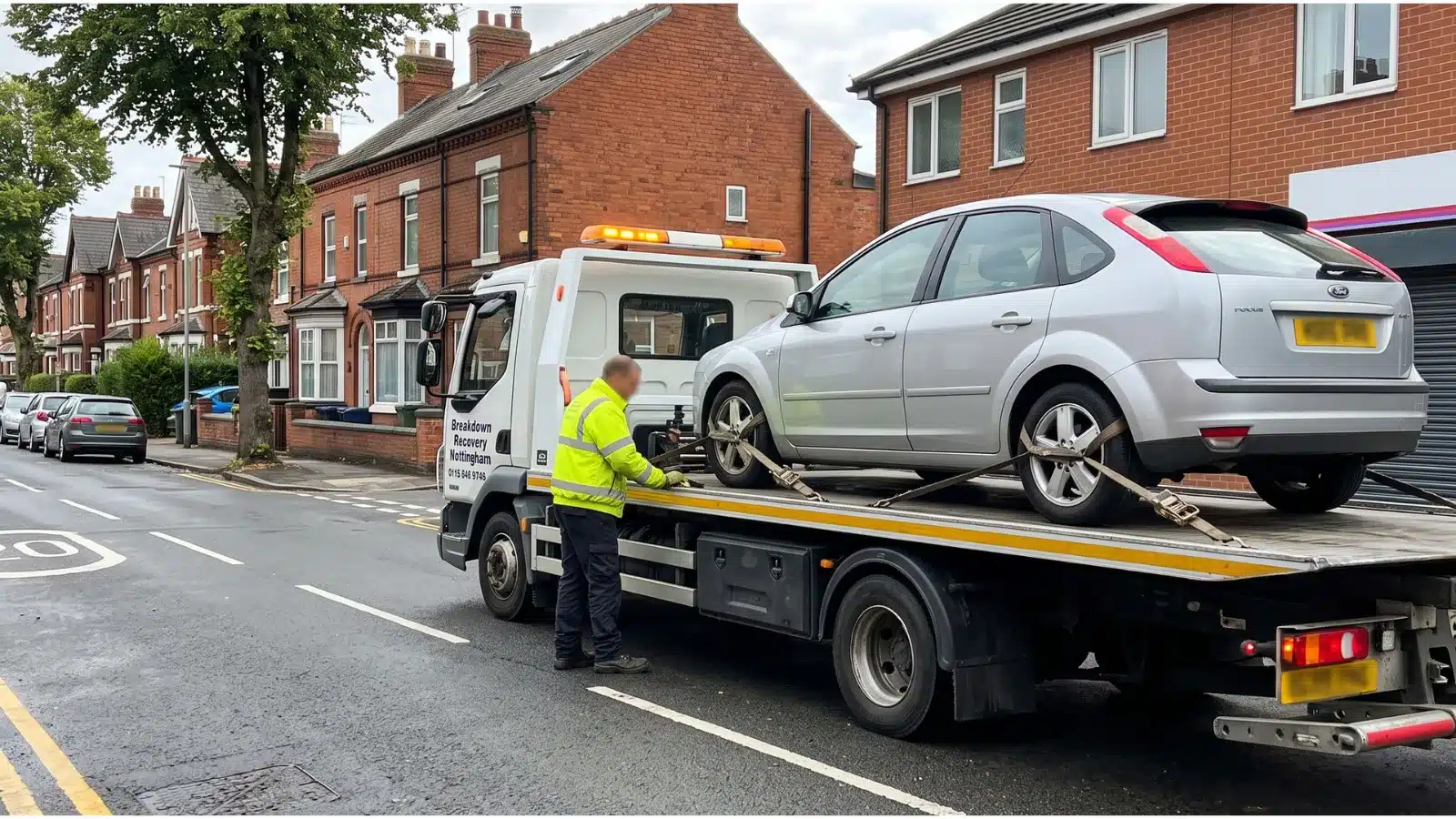
    Recovery driver securing a silver hatchback on a flatbed truck on a residential street

    Are you safe? If anyone is hurt or in danger, call 999 first, and don’t move an injured person unless they’re in immediate danger. On a motorway or fast road, if you can get out safely, leave by the side away from the traffic and wait behind a barrier. If you can’t get out safely, stay in with your seatbelt and hazard lights on, and call 999. There’s more on this under "While you wait" below.

    If you’ve never needed a recovery truck before, it helps to know what happens after you pick up the phone, even if you’d call it "calling a tow truck". This guide follows a breakdown recovery with Breakdown Recovery Nottingham from your first call to the moment your vehicle is handed over, so nothing comes as a surprise.

    The short version:

    1. You call 0115 646 9746 or WhatsApp your location.
    2. You tell us the vehicle, what’s happened and where it needs to go.
    3. We confirm the full price and an estimated arrival time.
    4. You pay, and we send the truck.
    5. The driver checks, loads and secures your vehicle.
    6. We deliver it and hand it over as agreed.
    Six stages of car recovery: contact us, share details, confirm and pay, driver checks, loading, and delivery
    Tap the illustration to view it at full size. The steps are also explained in the text.

    Plan your recovery

    Step 1: The call — what we ask and why

    The first call is where the job is planned. The more we know, the more accurate the price and the less chance of a surprise when the truck arrives. Expect to be asked about:

    • Where you are: the postcode, the road and nearest junction, or a location pin. On a main road, the direction you were travelling.
    • The vehicle: make, model and registration.
    • What happened: whether it rolls, steers and brakes, and any warning lights or leaks.
    • Where it needs to go, and whether someone there can take it in.
    • Who’s with you: adults, children, child seats, mobility needs or pets.
    • The keys: who has them and who will be with the vehicle when the truck arrives.
    • Access: height barriers, gates, a steep drive or soft ground.

    Your exact location matters most. It’s the first thing we need, and it’s the detail callers most often find hardest to give when they’re stressed or on an unfamiliar road. If you’re not sure, a WhatsApp location pin or a nearby landmark helps.

    Our advice hub has a short list of what to have ready.

    Sharing your location on WhatsApp

    Once you’re somewhere safe, you can send your location to 07926 542900 on WhatsApp. A pin is often quicker and more accurate than describing a road, especially in a car park, on an estate or on a stretch of road with no obvious landmarks. Sending a location doesn’t book the job on its own. The booking is confirmed once you’ve agreed the price.

    Car recovery call checklist: location, vehicle details, fault, destination, passengers, keys and vehicle access
    Tap the illustration to view it at full size. The steps are also explained in the text.

    Agree before dispatch

    Step 2: The price, payment and your arrival estimate

    Before anyone sets off, we confirm the full price for your job, covering where the vehicle is collected from, where it’s going and what’s included. Our call-outs start from £70, but that’s a starting price, not what every job costs. Our guide to how the price is worked out explains what changes it.

    The order is always the same: we confirm the price, you agree it (that confirms the booking), you pay, and then we send the truck. Some firms take payment at the end; we take it before dispatch. If anything changes later, such as a new destination or extra work, a revised price is agreed with you first. Our terms and conditions set this out.

    Your arrival time is an estimate, based on where you are, the traffic and the jobs already under way. We’ll tell you if it changes significantly. We don’t promise a set number of minutes, because no recovery firm can control the traffic.

    We take calls 24 hours a day, 7 days a week.

    Safety comes first

    While you wait: staying safe

    The wait is when people take risks they don’t need to. What to do depends on where you’ve stopped.

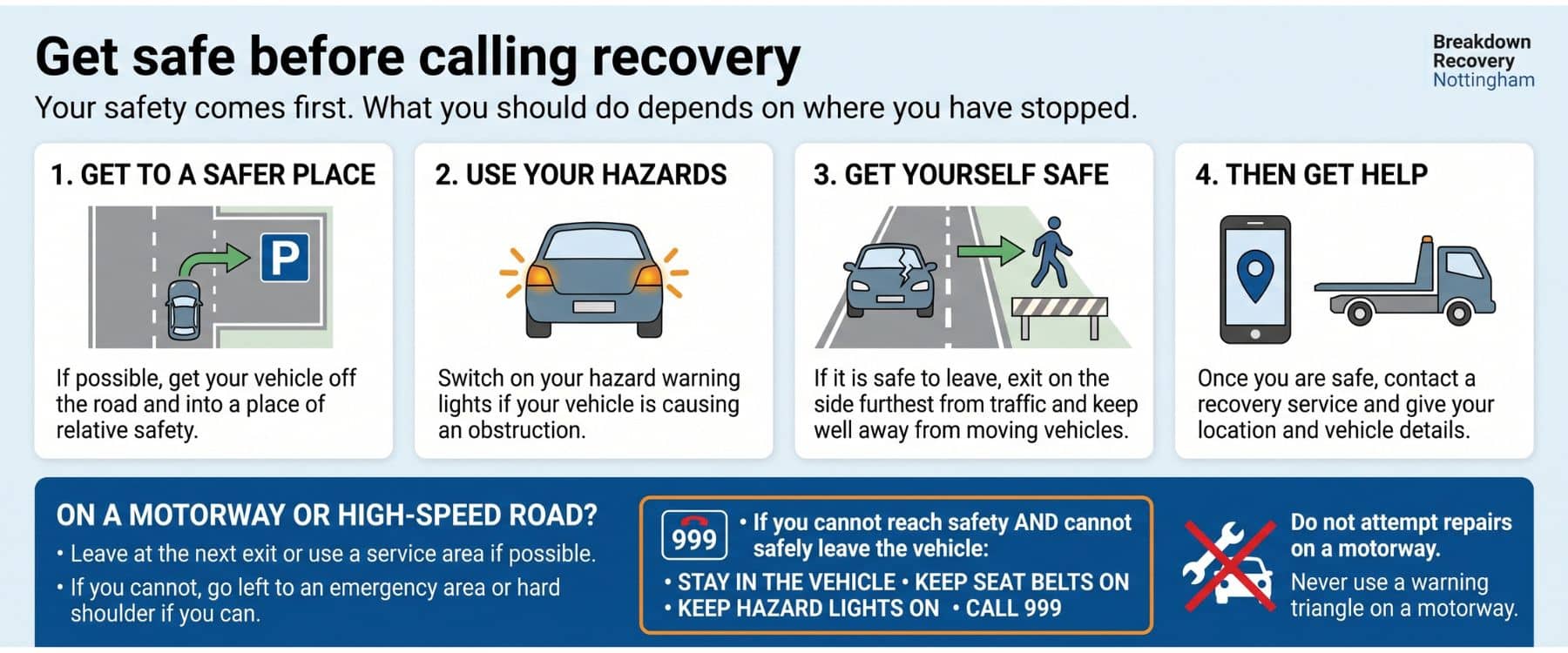
    On most roads (Highway Code rule 276):

    • Get the vehicle off the road if you can, and put your hazard lights on if it’s causing an obstruction.
    • Keep sidelights on if it’s dark or visibility is poor.
    • Wear something light-coloured or reflective if you have it.
    • Don’t stand, or let anyone stand, between the vehicle and oncoming traffic.

    On a motorway: go left, get safe, get help (Highway Code rule 277 and National Highways’ breakdown advice):

    • If you can, leave at the next exit or pull into a services before you stop.
    • Go left: if you can’t, move into the left lane, then into an emergency area or onto the hard shoulder if you can. Switch on your hazard lights.
    • Get safe: if it’s safe, leave by the side away from the traffic, with your passengers, and wait behind the safety barrier. Don’t go back to the vehicle, even if it’s cold or raining. Don’t try repairs, and don’t put out a warning triangle.
    • If you can’t get out safely, stay in the vehicle with your seatbelt and hazard lights on, and call 999 and ask for the police.
    • Get help: use the emergency telephone or call National Highways on 0300 123 5000 from a safe place, then call us.

    If a disability means you can’t follow this advice, rule 279 says to stay in the vehicle with your seatbelt on and hazard lights on, and call 999.

    Keep your phone switched on so we can reach you. If it’s safe, have the keys and any documents for the vehicle ready.

    Breakdown safety infographic comparing ordinary roads and motorways; full guidance is provided in the accompanying text
    Tap the illustration to view it at full size. The steps are also explained in the text.

    On arrival

    Step 3: When the truck arrives — what the driver checks

    When the driver arrives, they’ll first make sure it’s safe to work. They’ll then check that the vehicle, its condition and the access match what you told us, and confirm where it’s going.

    Keys and who needs to be there. The owner, or someone the owner has authorised, needs to be there with the keys. We don’t ask for ID. Tell us when you call who that will be.

    The vehicle’s condition. Point out any existing damage to the driver. Our driver takes photos of the vehicle’s condition, and you’ll be asked to sign a job sheet confirming the vehicle’s condition before the driver leaves with it. It’s still worth taking your own dated photos too.

    If the job is different. If the vehicle, its condition or the access turns out to be materially different from what was described, for example it won’t roll or there’s a height barrier, the driver explains the options and any extra cost, and nothing goes ahead until you’ve agreed.

    Can it be fixed where it is? Sometimes, yes. Where a simple roadside fix is possible, the driver may be able to get you going without loading the vehicle at all. If that happens, you pay the price you agreed before we set off. If you already know a fix is all you need, see roadside assistance.

    Recovery driver checking the front wheel and bodywork of a blue car before loading

    Loading your vehicle

    Step 4: Loading and securing your vehicle

    Your vehicle is loaded onto the recovery truck and secured for the journey. Please stay well clear of the truck and the vehicle while this happens.

    The driver does the loading. You don’t need to steer, brake or operate the vehicle. Just hand over the keys and keep well back. Our trucks have a tilt-and-slide bed, and loading usually goes like this:

    1. The bed comes down. The driver tilts the truck’s bed and slides it back until its end rests on the road behind or in front of your vehicle, making a ramp.
    2. The vehicle goes up. The driver attaches the winch to a suitable recovery point on the vehicle, such as its towing eye or another point its manufacturer allows, and draws it slowly up the ramp onto the bed. The right point and method depend on the vehicle and its condition. If it can move safely under its own power, the driver may drive it on instead.
    3. It’s strapped down. Once it’s in position, the wheels are secured to the bed with straps, so the vehicle can’t shift on the journey.
    4. The bed goes back. The driver levels the bed, slides it back into place and checks everything is secure before setting off.

    Your vehicle travels on the bed with its wheels off the road. It isn’t towed behind the truck on its own wheels.

    Some vehicles need extra care. Vans, motorbikes and accident-damaged cars each have their own page explaining what we ask about: van recovery, motorcycle recovery and accident recovery.

    Recovery driver winching a silver hatchback onto a lowered tilt-and-slide truck bed

    Passengers and pets

    Step 5: The journey — can you travel with us?

    Nobody stays inside the vehicle while it’s on the truck. That’s a firm rule in our terms, whoever is asking and however short the trip.

    Up to two passengers can travel in the truck cab, agreed when you book. Pets can come too. Tell us when you call who’s travelling, including any pets, children, child seats or mobility needs, so we can plan before the truck leaves. Anyone in the cab wears a seatbelt, as in any vehicle. If more than two people need to get somewhere, tell us when you call, so anyone who can’t travel in the cab has time to arrange other transport.

    At your destination

    Step 6: Delivery and handover

    We take the vehicle to the destination agreed when you booked: a garage, your home or another address. Before you book, it’s worth checking that a garage can take the vehicle when we arrive.

    • If the garage is closed: we only leave a vehicle there if it was agreed before we set off, with a safe place to leave it. The keys are left wherever the garage has asked us to leave them.
    • If it can’t go anywhere yet: storage is available at our yard in Long Eaton by agreement, at a rate confirmed before the vehicle goes in.
    • When it’s handed over: if you or someone you’ve named is there, check the vehicle before the driver leaves. If it’s left at a closed garage, check it as soon as you or the garage can. Either way, if you think something’s been damaged, tell us straight away and follow the steps in our terms.

    If you’re booking a move in advance rather than after a breakdown, see planned vehicle transport.

    Changes and cancellations

    If something changes on the way

    • A new destination or extra work: the revised price is agreed with you before we carry on.
    • You want to stop the job: you can, but we won’t unload your vehicle somewhere unsafe or unauthorised. We’ll agree a safe place with you.
    • We’re delayed: we’ll tell you, and you can decide whether to continue or cancel.
    • The car starts, or another recovery firm turns up: call us straight away. Another operator arriving doesn’t automatically mean you lose everything you’ve paid.

    If you cancel, in summary from our terms and conditions:

    • Before the truck is sent, with no work started and no justified loss: a full refund.
    • After the truck is sent or has arrived: a charge may apply, covering work already done and evidenced losses only. The rest of what you paid is refunded.
    • If we can’t provide the recovery we agreed: we refund what you paid for it.
    • Refunds are made within 14 days of cancellation. These terms don’t replace your legal cancellation rights.

    Your local team

    Who you’re dealing with

    Breakdown Recovery Nottingham is a team of six recovery drivers headed by Bradley. You’ll find us at breakdownrecoverynottingham.co.uk, written with no hyphen, and on 0115 646 9746. Before you book, check that the name and number match ours. Meet Bradley and the team, or see the areas we cover.

    Speak to our team

    Need recovery now?

    Call 0115 646 9746 or WhatsApp your location. We’ll confirm the full price before a truck is sent.

    Useful answers

    Questions about how recovery works

    Do you need my keys?

    Yes. The owner, or someone the owner has authorised, needs to be there with the keys when Breakdown Recovery Nottingham collects the vehicle. We don’t ask for ID, but tell us when you call who will be there.

    Can I travel in the recovery truck?

    Yes. Up to two passengers can travel in the cab of a Breakdown Recovery Nottingham truck, agreed when you book, and pets can come too. Tell us about any pets, children, child seats or mobility needs when you call.

    Can I sit in my car while it’s on the recovery truck?

    No. Nobody stays inside a vehicle while it’s being carried on a Breakdown Recovery Nottingham truck. If you’re travelling with us, you ride in the cab.

  • How much does car recovery cost in Nottingham?

    How much does car recovery cost in Nottingham?

    Costs and cover · Nottingham

    How much does car recovery cost in Nottingham?

    Broken down right now? Your safety comes before the price. If anyone is in danger, call 999. If you can get out safely, leave by the side away from the traffic and wait well away from the vehicle and the road, behind a barrier where there is one. If you cannot safely leave the vehicle and get well away from moving traffic, stay inside with your seatbelt and hazard lights on, call 999 and ask for the police. See the Highway Code breakdown rules. Our guide to being broken down without breakdown cover covers what to do first.

    The short answer: recovery call-outs with Breakdown Recovery Nottingham start from £70. That's a starting price, not a fixed charge. What you pay depends on the job, and we confirm the full price for your job before a truck is sent.

    The rest of this guide explains what moves the price, what a proper quote should tell you, and what to check before you pay anyone, whether that's us or another firm.

    Breakdown Recovery Nottingham flatbed truck carrying a secured blue car on a residential street

    What "from £70" means, and what it doesn't

    "From £70" is where Breakdown Recovery Nottingham's call-out prices start. It isn't a flat rate, an average or an estimate of what your recovery will cost.

    The number that matters is the total price for your job: the figure you agree to and pay. Under the Competition and Markets Authority's price transparency guidance, you must be given the total price, and a "from" price is acceptable only as long as it includes all applicable mandatory charges and does not mislead customers about what the price covers. Where a charge can't reasonably be worked out in advance, the business must give you prominent information about how it will be calculated. Unavoidable charges shouldn't be added as you go along ("drip pricing"). Before dispatch, we confirm the full price for your job, covering the collection point, the destination and the services agreed. Our terms and conditions set this out in section 5.

    For a consumer service contract, section 51 of the Consumer Rights Act 2015 says you must pay "a reasonable price… and no more" where you haven't already paid, the contract doesn't fix the price or say how it will be fixed, and no binding information given beforehand fixes it either. What's reasonable depends on the facts, and can be argued over afterwards, so it's far clearer to agree the total before the work starts.

    What changes the price of car recovery

    Infographic showing recovery quote factors: distance, vehicle type, rolling condition, location, timing and storage
    The infographic summarises distance, vehicle type, rolling condition, access, timing and storage. Tell the operator when recovery is needed and ask whether timing affects the quote; the agreed total is what matters. The table below explains the other factors.

    Online cost guides publish very different figures for a "typical" recovery, because each firm prices its work its own way. Rather than add another number, here's what affects a Breakdown Recovery Nottingham quote, and what to tell us so it's accurate first time.

    What affects the price Why it can change the price What to tell us
    Distance, to you and on to the destination More time on the road for the truck and driver Your exact location (postcode, what3words or a WhatsApp pin) and where the vehicle is going
    Vehicle type and size: car, van, motorbike, 4×4 or electric It can need a bigger truck or different loading equipment Make and model; for a van, whether it's loaded
    Condition: whether it rolls, steers and brakes A vehicle that won't roll takes more time and kit to load Does it roll? Are any wheels locked? Do you have the keys?
    Location and access: motorway, car park, verge, gated site Safe access can need extra time or equipment Height barriers, gates, narrow access, or whether it's off the road
    Destination Distance, and whether someone can receive the vehicle The garage or address, and whether it's open
    Waiting time or extra stops Time the truck and driver are tied up Any likely delay, or more than one drop-off
    Storage Charged separately, by agreement Whether the garage can take the vehicle today

    For vans and motorbikes, our van recovery and motorcycle recovery pages list the extra details we ask for. Waiting time and extra stops come up most on planned vehicle transport.

    Roadside fix or recovery?

    A jump start, wheel change or fuel delivery can sometimes get you going without moving the vehicle at all. These are priced as roadside jobs, not as recovery. Before we set off, Breakdown Recovery Nottingham tells you what you'd pay if the roadside fix doesn't work and what recovery would cost from there, so a failed jump start doesn't become a surprise bill. See roadside assistance for what each involves.

    Whole-job price or per-mile rate?

    Some firms charge per mile, some price by zone and some quote for the whole job, and published per-mile rates vary a lot between firms. A mileage figure on its own tells you little. Breakdown Recovery Nottingham confirms one total for the whole agreed job, from where the vehicle is to where it's going, before dispatch.

    Why recovery can cost more than people expect

    A recovery isn't just the miles with your car on the back. A truck and a driver are committed to your job from the moment they set off towards you until your vehicle is unloaded: the drive to reach you, the time to load and secure it safely, and any equipment needed for a car that won't roll. When you compare prices, compare the total for the whole job, not the starting figure.

    What a full quote should include, and what to ask

    Infographic with nine checks before agreeing to a recovery quote, explained in the checklist below
    Nine checks before you agree to a recovery quote. The full checklist is below. Tap the image to enlarge.

    Before you pay any recovery firm, check that the quote covers these:

    • ☐ The total price for this job, not just the starting price, and whether VAT is included if the firm charges it.
    • ☐ What it includes: where the vehicle is collected from, where it's going, loading, and any roadside attempt.
    • ☐ What could add to it, and confirmation that any change will be agreed with you first.
    • ☐ What you pay if a roadside fix doesn't work.
    • ☐ Storage, if it's needed: where, the rate, when charges start and how they stop.
    • ☐ When payment is taken, and how you can pay.
    • ☐ What happens if you cancel, before and after the truck sets off.
    • ☐ An estimated arrival time. It's an estimate, not a promise.
    • ☐ Who you're dealing with: check the firm's name and phone number match the firm you meant to call. Ours are Breakdown Recovery Nottingham, 0115 646 9746.

    Payment, cancellation and changes to the job

    Payment. Breakdown Recovery Nottingham takes full payment for the agreed job before dispatch, and explains how you can pay when confirming the booking.

    If the job changes when the truck arrives. A quote is only as accurate as the information it's based on. If the vehicle, its condition or the access turns out to be materially different from what was described, for example it won't roll or it's behind a height barrier, we explain the options and any extra cost, and nothing goes ahead until you've agreed. We won't charge extra to correct a mistake that's ours. The best way to avoid a change on the day is to give as much detail as you can when you first call.

    If you cancel. Our terms and conditions (sections 12 to 20) set out the detail. In summary:

    • Before dispatch: we refund your payment in full where no work has started and no justified loss has been incurred. If we've had unavoidable costs, we explain any deduction and how we worked it out.
    • After dispatch or arrival: a cancellation charge may apply. It covers work already done and evidenced losses, and we refund the balance of what you paid.
    • If we can't provide the agreed recovery: we refund the amount paid for the service we didn't provide.
    • Refunds are issued within 14 days of cancellation. These terms don't replace your legal cancellation rights.

    What if you don't have breakdown cover?

    Do not buy an ordinary breakdown policy online expecting it to cover a breakdown that has already happened. Phone the provider and explain the situation; any emergency assistance, charges and membership requirements depend on its terms. Our guide to being broken down without breakdown cover explains how to check what you're covered for, and what to do if you aren't covered.

    Police recovery charges and council parking removals

    Private recovery bookings and official vehicle removals are priced differently. The table below shows the statutory road-traffic recovery charges set in 2023 for a vehicle with a maximum authorised mass of up to 3.5 tonnes (other than a two-wheeled vehicle), for the removal circumstances listed. It doesn't cover every police or council removal, and it isn't a guide to private recovery prices.

    Police or authority removal Fee
    On the road, upright and not substantially damaged £192
    On the road, not upright or substantially damaged £320
    Off the road, upright and not substantially damaged £256
    Off the road, not upright or substantially damaged £384
    Storage, for each 24 hours or part of 24 hours £26
    Disposal, where the applicable statutory regime provides for this charge £96

    These charges have applied since 6 April 2023, under the Removal, Storage and Disposal of Motor Vehicles (Amendment) Regulations 2023 and Home Office Circular 003/2023.

    Council parking removals use a different tariff. For vehicles removed for parking contraventions, Nottingham City Council's vehicle pound publishes a £105 removal fee plus the Penalty Charge Notice, with storage at £12 a day once the vehicle has been held for more than 24 hours. Check your removal notice and the relevant authority's vehicle pound information to see which charges apply to you. If you've been in an accident, see our accident recovery page.

    Get a price for your recovery

    Call or WhatsApp Breakdown Recovery Nottingham with where the vehicle is, what it is, what's wrong with it and where it needs to go. Our call-outs start from £70, and we'll confirm the full price for your job before a truck is sent.

    For questions that aren't urgent, use our contact page.

    Questions about recovery costs

    Is there a call-out charge for breakdown recovery?

    Breakdown Recovery Nottingham's call-outs start from £70. Rather than quoting a call-out fee and a mileage charge separately, we confirm one full price for the agreed job before dispatch, covering the collection, the destination and the services agreed. With any firm, ask for the total, not just the call-out figure.

    How much does police vehicle recovery cost?

    Under the 2023 statutory road-traffic recovery charges, removing a vehicle of up to 3.5 tonnes maximum authorised mass (other than a two-wheeled vehicle) from the road costs £192 if it's upright and not substantially damaged, or £320 if it isn't. Storage is £26 for each 24 hours or part of 24 hours. Other removals, including council parking removals, can have different charges: Nottingham City Council publishes a £105 removal fee plus the Penalty Charge Notice. None of these figures apply to private recovery bookings.

    Sources checked 12 October 2026: Home Office Circular 003/2023; SI 2023/331, Schedule; CMA price transparency guidance (CMA209); Nottingham City Council vehicle pound; Consumer Rights Act 2015, section 51; Highway Code, breakdowns and incidents; our terms and conditions. This guide is general information, not legal advice.

  • Broken down without breakdown cover? Your options in Nottingham

    Broken down without breakdown cover? Your options in Nottingham

    Practical breakdown advice

    Broken down without breakdown cover? Your options in Nottingham

    You can still get help if you've broken down without breakdown cover. Once you're safe, you can phone a breakdown provider for emergency assistance or book a local recovery firm for this one job.

    What to do now

    1. Get safe first. If anyone is injured or in immediate danger, call 999. Follow the safety guidance below.
    2. Check existing cover. Look at your insurance, bank account or vehicle agreement before paying separately.
    3. Phone for help. Explain that you have already broken down. Don't buy an ordinary policy online to cover an existing breakdown.
    4. Agree the total price and destination before anyone sets off. Ask about any membership commitment.
    Recovery driver beside a car with its bonnet raised and a recovery truck on a residential street

    First, get yourself and your passengers safe

    Breakdown safety infographic: stop somewhere safer if possible, use hazard lights, get away from traffic safely and call for help; full guidance follows
    Safety summary. Read the full guidance below. Tap the image to enlarge.

    Your safety comes before cover or cost. These steps follow the Highway Code (rules 275 to 283) and National Highways.

    If anyone is injured, or there's a fire or immediate danger

    Call 999 first. Don't move injured people from a vehicle unless they're in immediate danger. Arrange recovery only once the emergency services have dealt with the scene and it's safe to do so.

    Broken down on a motorway without cover?

    • If you can, leave at the next exit or pull into a service area.
    • Go left. If you can't leave, move into the left lane and, if you can, pull into an emergency area or onto the hard shoulder. Stop as far left as possible, with your wheels turned to the left and your hazard lights on.
    • Get safe. If it's safe and possible, get out on the side furthest from traffic and make sure your passengers do the same. Wait well away from your vehicle and the traffic, behind a barrier where there is one, and watch for drops or debris beyond it. Don't go back to your vehicle, don't try repairs, and never put a warning triangle out on a motorway.
    • If you can't get out safely. If you can't leave the vehicle safely and get well away from it and moving traffic, stay inside with seat belts and hazard lights on. Call 999 immediately and ask for the police, or press your car's SOS button.
    • Get help. Use the free emergency telephone, or call National Highways on 0300 123 5000. Then contact a breakdown recovery service, and tell them if you're disabled, older or travelling alone.
    • Leaving an emergency area. You must use the emergency telephone and follow the operator's advice before rejoining the motorway.

    Drivers with a disability who can't follow these steps should stay in the vehicle with their seat belt on and hazard lights on, and call 999. If you're deaf, hard of hearing or speech-impaired, the Highway Code recommends registering for the 999 text service before you travel.

    To give your location, use a mapping app or read out the numbers on the nearest marker post or driver location sign.

    On other roads

    • Get off the road if you can. Use your hazard lights if you're causing an obstruction.
    • Wear light-coloured or fluorescent clothing in daylight and reflective clothing at night.
    • Only put out a warning triangle if you can do so safely. Place it at least 45 metres behind your vehicle, on the same side of the road. Never stand between your vehicle and oncoming traffic.

    If you break down on a level crossing, get everyone out and clear straight away, and use the railway telephone. Recovery can wait.

    Check whether you already have cover

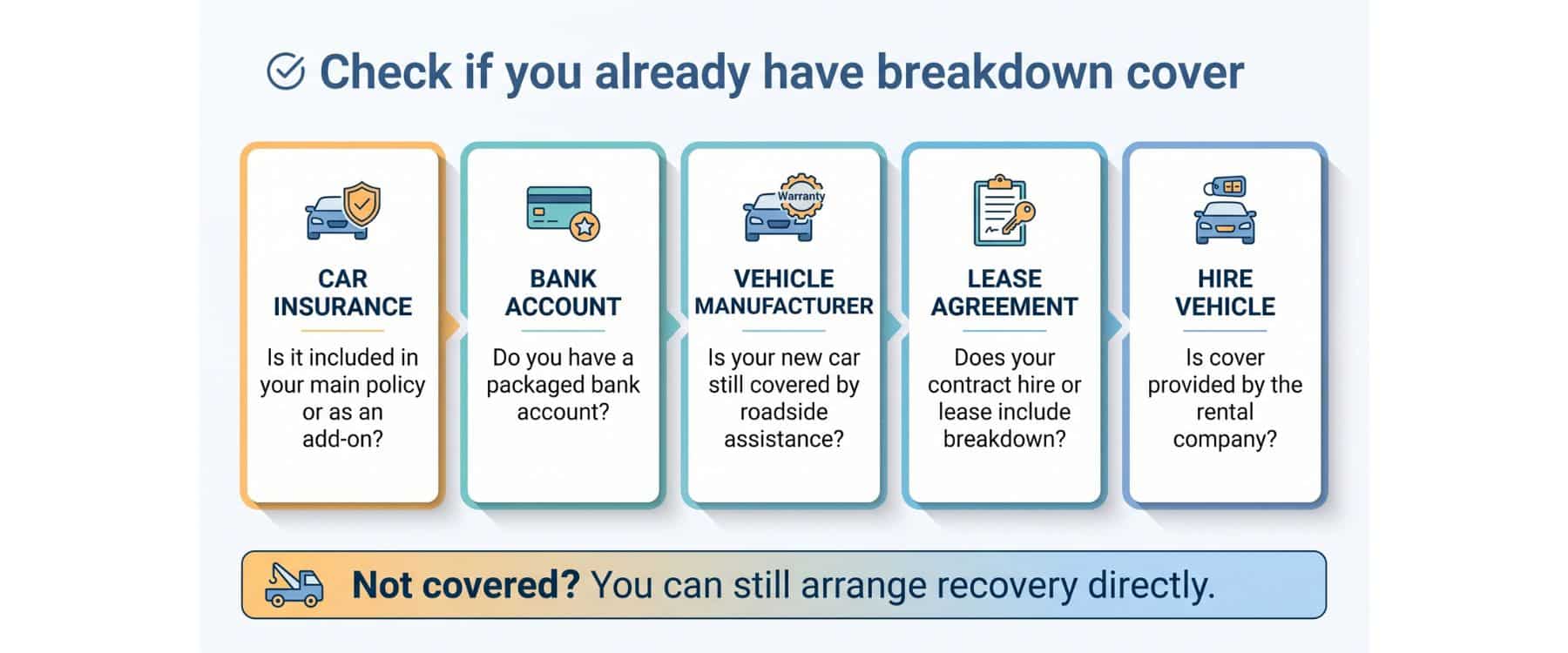
    Infographic showing five places to check for existing breakdown cover; the checklist is explained in the accompanying text
    Five places to check before paying for recovery. The full checklist is below.

    Before you pay for anything, check these five places for cover you may have forgotten:

    • Car insurance. MoneySavingExpert says car insurance usually doesn't include breakdown cover, but some insurers offer it as an add-on. Check your policy documents or call your insurer.
    • Packaged bank account. MoneySavingExpert says many fee-paying bank accounts include breakdown cover. Check your banking app or account benefits.
    • Manufacturer assistance. Which? says most manufacturers include free breakdown cover on new cars for a limited period, usually one to three years. Check your handbook or service book.
    • Lease, hire, company or fleet vehicle. Check your agreement or ring the company first. Many arrange recovery through their own provider.
    • Personal cover. Personal cover protects the person rather than the vehicle. Ask whether anyone travelling with you has a personal policy. It may cover them on this journey, subject to the policy's terms.

    The RAC suggests checking your emails and paper documents, or calling a provider to ask whether you're covered.

    If you find cover, call that provider first and confirm it covers this breakdown. Basic cover can have limits. Which? notes, for example, that basic roadside cover often excludes breakdowns within a quarter of a mile of home. If your cover does apply, use it rather than booking a separate firm as well.

    For vans and motorbikes, see our van recovery and motorcycle recovery pages, which explain how to check cover for those vehicles. After a collision, see accident recovery.

    Can you buy breakdown cover after breaking down?

    An ordinary breakdown policy is for breakdowns that happen after you've bought it. If you've already broken down, the big providers ask you to phone them for emergency help rather than buy a policy online. Here's what each one says:

    Provider What they say Checked
    RAC If you buy cover online after breaking down, they won't be able to attend, and extra charges apply before they send help. Phone them for instant emergency cover instead. 6 Oct 2026
    AA If you've broken down, call them rather than buy online. Cover bought online can only be used 24 hours after purchase and doesn't cover pre-existing faults. 6 Oct 2026
    Green Flag You can't take out a policy and get their help for a breakdown that has already happened, but they can still help if you phone, for a one-off fee. 6 Oct 2026

    Rules vary between providers. MoneySavingExpert says joining at the moment you break down can mean paying a hefty surcharge, and that some providers have a 14 to 30-day waiting period before you can claim for a new breakdown. Sort out cover for the future calmly, once you're home.

    Your options if you have no cover

    If you've confirmed you have no cover, there are two main routes. You can phone a breakdown provider for emergency help, or book a local recovery firm directly for this one job.

    Option 1: Phone a breakdown provider

    • RAC: charges a fee for emergency recovery. If the vehicle can't be fixed on the spot, a tow of up to 10 miles is included, and you can pay to go further.
    • AA: you join as a member and pay a surcharge. If the patrol can't fix the vehicle at the roadside, they tow it to a nearby garage.
    • Green Flag: charges a one-off fee for the callout.

    None of the pages we checked states an emergency price, so ask for one on the phone. Each provider's number is on its official page, linked in the table above.

    Option 2: Book a local recovery firm directly

    You book one recovery job and agree its price before dispatch. There's no membership to join. You choose where the vehicle goes: a garage, your home, or storage by separate arrangement. With us, payment is due once the price is agreed and before we're dispatched. See breakdown recovery in Nottingham.

    Another possibility: a local garage

    The RAC lets non-members choose which garage their vehicle is taken to. If you'd rather contact a garage yourself, bear in mind it may not be open, or able to collect, at the time you need it.

    Infographic comparing existing breakdown cover with one-off recovery; prices, commitments and destinations are explained in the comparison table
    Options at a glance. The table below explains the differences, including emergency help from a provider.

    How the routes compare

    Cover you already have Phoning a breakdown provider Booking a local firm directly
    Who you ring The number in your policy, account benefits or handbook The provider's emergency line (see its official page) The firm directly. For us: 0115 646 9746 or WhatsApp 07926 542900
    What you pay Check whether this call-out is included, and any limits RAC and Green Flag: a fee for the emergency callout. AA: membership plus a surcharge. Ask for the price first A price for this job, agreed before dispatch. Our call-outs start from £70
    Ongoing commitment Your existing policy AA: you become a member. RAC and Green Flag: a fee for this callout. Ask about any ongoing cover they offer None. You pay for the job you need
    Where the vehicle goes Depends on your policy RAC: a 10-mile tow included, with the option to pay for further. AA: a nearby garage if it can't be fixed Agreed when you book: a garage, your home or chargeable storage
    Watch out for Basic cover may exclude breakdowns at or near home (Which?) Don't buy a policy online after breaking down Confirm payment, passengers and cancellation terms before agreeing

    If your vehicle may only need a jump start, wheel change or fuel delivery, see our roadside assistance options.

    Need a recovery truck now and have no cover? From somewhere safe, call 0115 646 9746 or WhatsApp us. If anyone is injured or in immediate danger, call 999 first.

    Before you agree to a recovery: what to check

    Whoever you book, confirm these points before anyone sets off:

    • ☐ The total price, and exactly what it covers: collection, destination, and any storage or extra work.
    • ☐ When payment is due and how you can pay.
    • ☐ Where your vehicle is going, and whether someone there will accept it. If the garage will be closed, has the drop-off and key handover been agreed?
    • ☐ How many people need to travel. Passenger places must be agreed before dispatch.
    • ☐ That the owner can be there with the keys at collection, or that another arrangement has been agreed.
    • ☐ The estimated arrival time. It's an estimate, not a promise.
    • ☐ What happens if your car starts, or another firm turns up.
    • ☐ If you hope to claim the cost back, ask your insurer to approve it first. An invoice doesn't guarantee you'll be reimbursed.

    For the details you'll need to give a recovery operator, see our breakdown and recovery advice. Our prices and payment terms are in our terms.

    Don't end up paying twice

    It's easy to ring a provider and then a local firm "just in case", or for a friend to ring someone on your behalf. That's how people end up paying twice.

    Choose one route, and tell anyone else you've contacted straight away. If you've booked us and your vehicle starts, or another operator arrives, contact us immediately. Our cancellation terms say another operator arriving doesn't automatically mean you lose your entire payment. Any amount we keep depends on work already done and justified losses from the cancellation. If you cancel before dispatch and we haven't started work or incurred a justified loss, we refund your payment in full.

    Other firms have their own cancellation terms, so if you've booked elsewhere, check theirs too.

    Booking with Breakdown Recovery Nottingham when you have no cover

    Three recovery team members in high-visibility clothing beside a recovery truck carrying a car

    Breakdown Recovery Nottingham is a local recovery team of six drivers, headed by Bradley (meet the team). You don't need breakdown cover to use us. You can call us directly and pay for the job you need.

    How a booking works:

    1. Call or WhatsApp us from somewhere safe. Tell us where you are, the vehicle's make, model and registration, what's happened, where you want it taken, and how many people are with you.
    2. We tell you whether we can take the job, then confirm the full price and give you an estimated arrival time.
    3. You agree the price and pay before we're dispatched. We explain the available payment arrangements when we confirm your booking. If you expect your insurer to pay, tell us whether you need its approval before paying. Sending a message or sharing your location doesn't confirm a booking on its own.
    4. We load and secure your vehicle and take it to the destination you agreed. That can be a garage, your home, or our storage in Long Eaton, which is chargeable and arranged separately.

    Call-outs start from £70. That's a starting price, not a fixed charge for every job, and we confirm the full price before dispatch. Up to two passengers can travel with us, subject to suitable seating and agreed before dispatch. Nobody can stay inside a vehicle while it's on the recovery truck.

    We recover cars, vans and motorcycles. Our recovery service runs 24 hours a day, subject to availability and safe access. Arrival times are estimates and depend on location, traffic and other jobs. We handle M1 enquiries around Nottingham, but attendance depends on safe access and any police or traffic-officer instructions.

    We cover Nottingham and Nottinghamshire, including Beeston, West Bridgford, Arnold and Hucknall, routes such as the A52, A60, A610 and A453, and nearby Long Eaton. See all areas we cover.

    Breakdown Recovery Nottingham: 0115 646 9746 · WhatsApp 07926 542900. For non-urgent questions, contact us.

    Common situations

    Broken down at home or on your drive

    The RAC says non-members with a car broken down at home can call its non-member number. The AA says to call it if you don't have its At Home cover. We also collect from driveways. When you book, tell us about anything that affects access, such as whether the car is on a driveway or the street, a height barrier, a narrow entrance or difficult ground.

    If the vehicle is already somewhere safe and you need to arrange a move for a booked date, see our vehicle transport service.

    After a collision

    Safety and any police instructions come first. Your insurer may arrange recovery, so check before booking a second firm. Our accident recovery page explains when to call your insurer and when to book yourself.

    Van, motorcycle, lease or company vehicle

    See van recovery or motorcycle recovery. For a lease, hire or company vehicle, check your agreement or ring the company first, because many arrange recovery through their own provider.

    Questions people ask

    Is it illegal not to have breakdown cover? No. The RAC confirms breakdown cover isn't a legal requirement.

    Will my car insurance pay for breakdown recovery? Not usually for a mechanical breakdown. MoneySavingExpert says car insurance usually doesn't include breakdown cover unless you added it, so check your documents. After a collision the position is different: speak to your insurer before booking, and get its approval first if you hope to claim the cost back.

    How much does recovery cost without cover? It depends on the job: the distance, the vehicle, access and the destination. Our call-outs start from £70, and we confirm the full price before dispatch.


    Broken down with no cover in or around Nottingham? Get safe first. Then call 0115 646 9746 or WhatsApp us, and we'll confirm the price before anyone sets off. If anyone is injured or in immediate danger, call 999.